


Getting a dental crown will be one of their best moments. But when thinking of dental crowns and the terms associated with them, they are often considered expensive and slightly dramatic.
If your dentist mentioned you needed one, there’s probably a reason. It may be due to a cracked molar you got while chewing popcorn, there may have been damage after a root canal, or maybe you’ve been staring at that front tooth with a chip from every angle and are simply wondering when you might stop thinking about it.
The next question we all wonder about is, what are the actual purposes of a dental crown, or ONLY purposes? How long do Dental Crowns actually last?
Here’s the human side of getting a dental crown, including its many purposes and the time and money involved.
What Is the Purpose of a Dental Crown?
At its core, the purpose of a dental crown is simple: protection.
Think of crowns as tooth helmets or fitted hats that wrap snugly around the teeth. They are placed over the visible parts of your teeth, above your gums, and will help restore your tooth’s shape, appearance, size, and strength. So, why would you put a dental crown on?
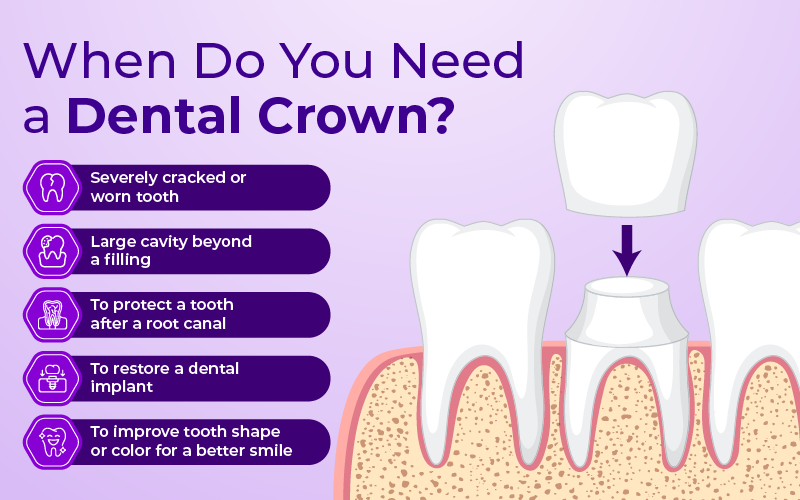
The purpose of a dental crown on a tooth is to protect and preserve it when that tooth has been damaged enough that it cannot support itself, but it is still in good enough condition to be kept. Dental crowns will typically be recommended by your dentist in situations when:
- The tooth has become severely cracked or has lost a lot of enamel due to normal wear and tear.
- The tooth has a large cavity, and it cannot be saved with a traditional filling.
- After a root canal is performed, the tooth’s structure is weakened.
- When getting a dental implant and needing to make the visible part of the implant, back onto the implant;
- When the shape or colour of a tooth is a factor in how someone feels about their smile.
Here’s what many people don’t understand: when teeth lose enough of their structure to be compromised, they will not just “get better.” Enamel does not grow back. Therefore, the best answer to “What is the purpose of a dental crown?” is that it helps prevent small problems from becoming larger, more painful, and more costly problems later on. And this is not dramatic. This is just a part of the world of dentistry.
Crowns Aren’t Just Cosmetic
Many individuals believe that the primary function of crowns is aesthetic enhancement. In that sense, crowns serve as decorative pieces, similar to the decorative veneers that enhance the beauty of your smile.
Crowns can significantly improve the appearance of your teeth; however, they also provide structural reinforcement.
After a root canal, the infection is gone; however, the tooth remains an empty shell and is now brittle (like an old tree branch). When a person eats or chews on food that is too hard for an empty tooth, it can crack, and they will require emergency treatment.
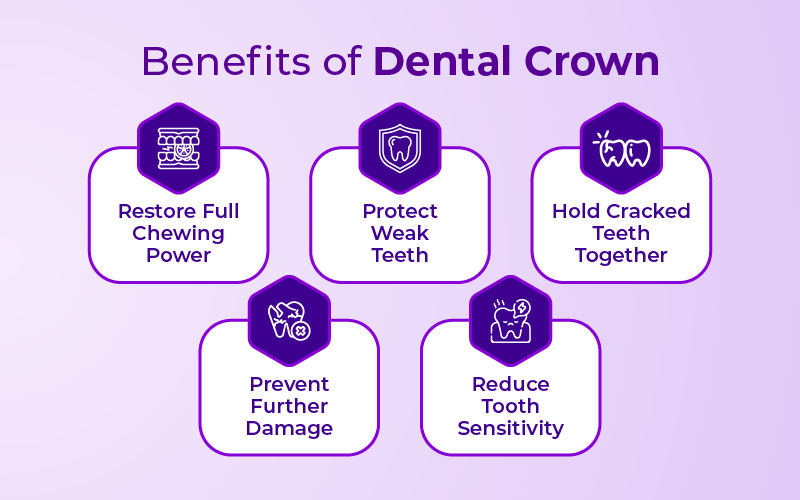
Being able to chew opens the door to the benefits of crowns:
- Crowns Restore Full Chewing Function
- Crowns Protect Weak Teeth from Cracking
- Crowns Help Hold Cracked Teeth Together
- Crowns Help Prevent Further Decay/Damage
- Crowns Reduce Tooth Sensitivity
In many instances, the placement of a crown may mean the difference between keeping your natural tooth and losing it completely. Keeping your natural tooth is almost always a better choice than replacing it.
Types of Dental Crowns: Not All Crowns Are Created Equal
Let’s talk options.
When people hear “crown,” they imagine one thing. But there are several types of dental crowns, and the right one depends on your needs, budget, and the location of the tooth.
Here’s a quick breakdown:
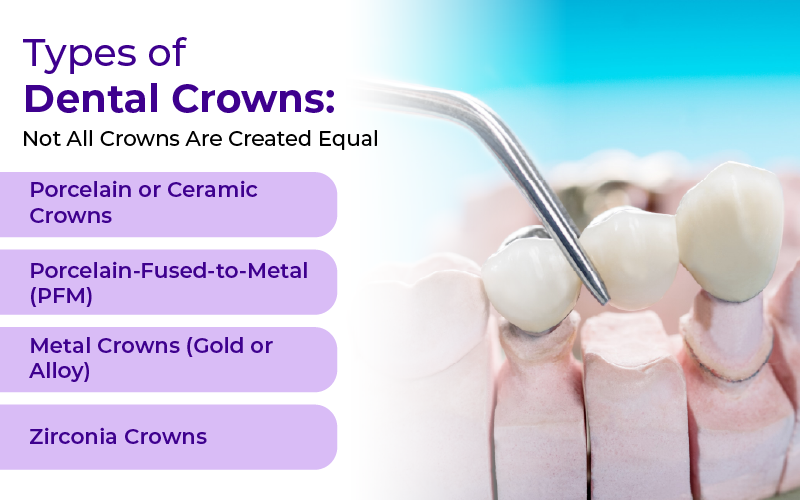
Porcelain or Ceramic Crowns
Porcelain/ceramic crowns are generally used for front teeth because they’re the most life-like and blend in well with your other teeth.
Porcelain-Fused-to-Metal (PFM)
Porcelain-fused-to-metal (PFM) crowns are a strong & aesthetic option as they have a metal base for strength and porcelain top for aesthetics.
Metal Crowns (Gold or Alloy)
Metal crowns (gold or alloy) are extremely strong but not very subtle. They would typically be used for back molars, where aesthetics is less important, and chewing pressure is high.
Zirconia Crowns
Zirconia crowns are also a modern, highly popular solution because they have both strength and aesthetic appeal.
While all types of materials can be used for crowns, each has pros and cons, but they all share the same goal: to protect natural teeth and restore tooth function. To find out which option best fits your needs, please talk to your dentist. Don’t expect to get gold crowns unless specifically requested.
How Long Do Dental Crowns Last?
How long do dental crowns last? This is the question most people want to know and, invariably, the first question they ask when they hear the crown’s price.
The average life expectancy of a crown is 10 to 15 years, but crowns will sometimes last longer than the average life span. So the better answer is: “It all depends on you.”
Crowns can last 20 years or longer with proper care, but the life of a crown will be reduced if you grind your teeth at night, chew on ice, or use your molars to open bottles (PLEASE don’t!).
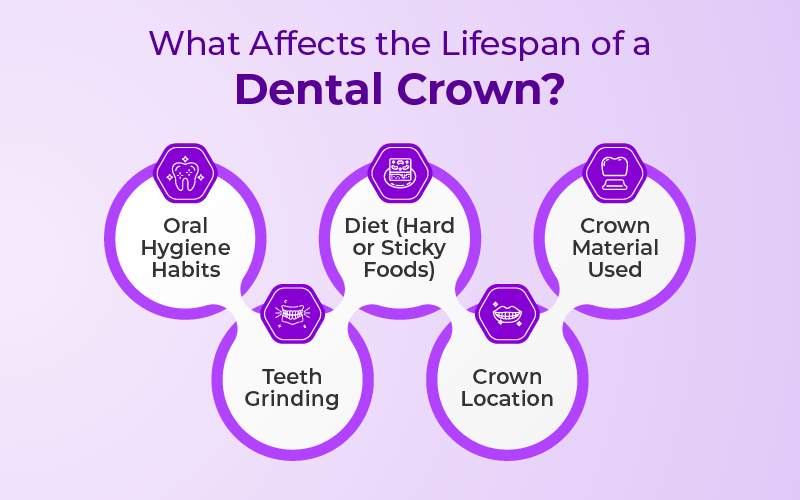
Things that can affect the life of your crown are:
- Oral hygiene
- Teeth grinding (bruxism)
- Your diet (what type of foods you eat that are hard/chewy/sticky)
- Where the crown is placed (front teeth or back teeth)
- The material the crown is made from
Crowns do not require any special maintenance other than regular brushing, flossing, and dental visits. Treat your crown like a normal tooth because it is attached to one.
People often start to doubt if their crowns were “worth getting.” After protecting a damaged tooth for up to 15 years, that is a good investment.
The Emotional Side of It
Visits to the dentist during treatment can leave a person feeling exposed. There you lie in a dentist’s chair, with your mouth open and with overhead light upon you, while your dentist is discussing the need for drilling and then cementing.
Not a location or setup to help you relax with all that going on.
There is, however, something empowering about fixing a dental problem rather than continuing to ignore it, especially when it affects your ability to eat, talk, and/or smile.
In addition to restoring the appearance of your smile, another reason to consider crowns is their role as structural support and the many benefits as it relates to your overall health:
- Provides increased confidence in your smile
- Relieves/reduces long-term pain associated with restorative work
- Allows you to eat with the restored tooth comfortably
- Helps decrease the risk of needing to visit the dentist for any emergency dental issues
- Enjoy the peace of mind knowing your tooth will not break off when you bite into food.
And if you have had a tooth crack and then it gets worse very quickly, you understand how quickly your “I’ll take care of it later” attitude can turn into “Why didn’t I do this sooner?”
Are Dental Crowns Worth It?
This is the moment when people typically hold back.
Dental crowns are not inexpensive. You’re right!
However, in most cases, there is also a large cost associated with having an extraction followed by an implant or bridge. These procedures are more invasive and costly than a crown, which preserves what you already have: your natural tooth.
This is an important point.
If your tooth has already been extracted, it can be very complex (and cost-prohibitive) to replace it compared with simply protecting it.
The “best” dental decision may not be the most extravagant one; it may just be preventive measures, quiet and responsible.
And let’s be honest, this is an intelligent way of handling your oral health.
Conclusion
If your dentist is discussing a crown with you, it’s not at all about making your back teeth look pretty. They believe your tooth needs some extra help.
Crowns were made to protect and provide strength and lasting value rather than for aesthetic reasons. It’s repairing a crack before it breaks. In other words, it’s a way to bolster something weak rather than letting it fail from a lack of protection.
So ask yourself: Are you avoiding a crown or are you avoiding peace of mind?
Your teeth do so much for you every day, so is it too much to give a tooth to someone who needs some ‘armor’ and strength?
Frequently Asked Questions
A tooth may need a crown if it has severe fractures, is weakened by decay, or has had a root canal. Crowns are typically used to restore chewing ability and protect the remaining tooth from further damage, which could lead to its loss.
In general, your dentist will use local anesthesia to minimize discomfort during the procedure, but patients often find it less uncomfortable than they anticipate. Also, modern methods make getting a dental crown faster than many individuals expect.
The process of getting a dental crown usually requires two office visits: the first to prepare the tooth and take impressions, and the second to insert and adjust the custom crown to restore the tooth's strength and function.
A dental crown should be cared for like a natural tooth. You should brush your teeth twice per day and floss regularly. You should also avoid chewing on hard objects. Additionally, you should continue routine dental visits to check that the dental crown and the tooth it is attached to are healthy.