


The child you brought into the world has only a few teeth, so it is unlikely that you have made a dentist appointment yet. Alternatively, you are wondering if you must do so.
Well, according to the American Dental Association (ADA) and the American Academy of Pediatric Dentistry (AAPD), you need to do it.
It may seem like you are making an appointment too early. Your child can’t pronounce the word “tooth” yet.
However, the initial visit to the dentist with your kid is not about the treatment. Rather, it is all about checking whether teeth are healthy and at risk of decay.
Following the dentist’s advice will also be useful.
When Should a Child Have Their First Dental Visit?
All children should be seen by a dentist by age one or within six months of the first tooth.
You do not need to wait for all of your child’s teeth to grow in. Waiting until there is a problem is not the best strategy.
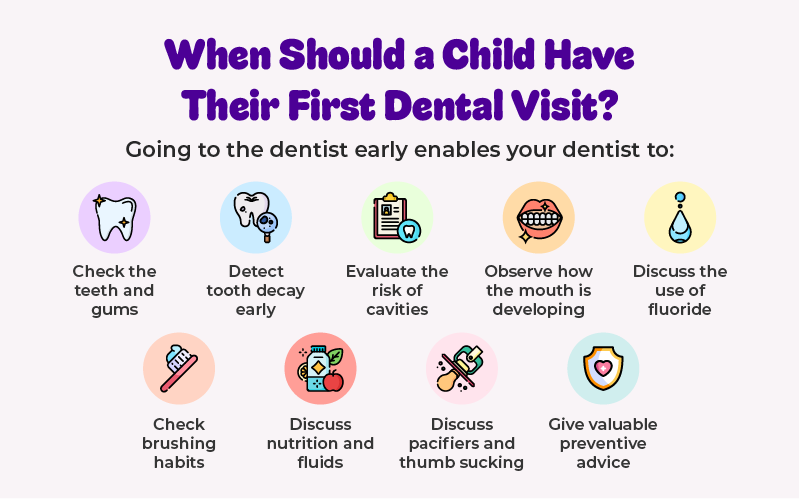
Going to the dentist early enables your dentist to:
- Check the teeth and gums of your child.
- Detect tooth decay early.
- Evaluate the likelihood of cavities.
- Observe how the mouth is developing.
- Discuss the use of fluoride.
- Check the brushing habits.
- Discuss the nutritional fluid your child is consuming.
- Discuss the use of pacifiers, thumb sucking…
- Give you valuable preventive advice.
AAPD recommends that every child should have a “dental home” by age 12 months to receive preventive care on an ongoing basis.
What if your child is older than one?
Do not worry.
If your child has not been to the dentist yet, do not keep reflecting on this.
Make an appointment as soon as possible.
What If Your Child Is Already Older Than One?
Don’t worry.
If your child has never seen a dentist before, you should simply book an appointment. There is no use feeling guilty about failing to do so earlier. What is important is to begin now.
WHAT HAPPENS DURING A CHILD’S FIRST DENTAL VISIT?
This is probably the question that’s making you most nervous.
The good news? A first dental visit is usually pretty straightforward.
Depending on your child’s age, comfort level, and the dental office, the dentist may examine the teeth and gums, look at the bite and jaw development, assess cavity risk, and discuss your child’s oral-health routine.
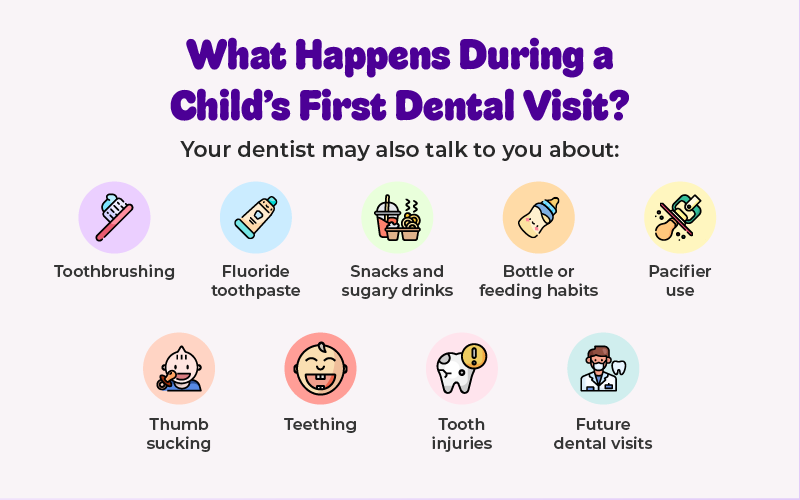
Your dentist may also talk with you about:
- Toothbrushing.
- Fluoride toothpaste.
- Snacks and sugary drinks.
- Bottle or feeding habits.
- Pacifier use.
- Thumb sucking.
- Teething.
- Tooth injuries.
- Future dental visits.
The appointment is also an opportunity for you to ask questions. And please ask them.
Your Child Doesn’t Have to Cooperate Perfectly
This is worth saying because parents sometimes put unnecessary pressure on themselves.
Your toddler may cry.
They may refuse to open their mouth.
They may suddenly become fascinated by the waiting-room chair and have absolutely no interest in meeting the dentist.
That’s okay.
The first dental appointment isn’t a behavior exam.
A dentist who regularly treats children understands that young patients can be nervous or unpredictable. The team can often slow things down, explain what’s happening, or give your child time to become comfortable.
How Do You Prepare Your Child for Their First Dental Visit?
You don’t need a complicated preparation plan.
Keep the explanation simple and positive.
You could say:
“We’re going to visit the dentist. They will look at your teeth and help us keep them healthy.”
That’s enough for most young children.
Play dentist at home.
A little pretend play can make the appointment feel less unfamiliar.
Take turns being the dentist and patient. Count each other’s teeth. Let your child look inside your mouth. You can even brush the teeth of a favorite stuffed animal.
Yes, it may feel a little silly.
That’s fine.
You’re giving your child a chance to see that someone looking at their teeth isn’t a strange or threatening experience.
Avoid Scary Words
Try not to use words such as:
- Pain
- Injection
- Drill
- Needle
- Hurt
Even when you’re trying to reassure your child, mentioning these things can introduce ideas they weren’t worried about in the first place.
Instead, let the dental team explain procedures using child-friendly language.
And don’t promise that nothing uncomfortable will ever happen. You can’t predict every future dental appointment.
WHAT SHOULD PARENTS BRING TO THE FIRST DENTAL APPOINTMENT?
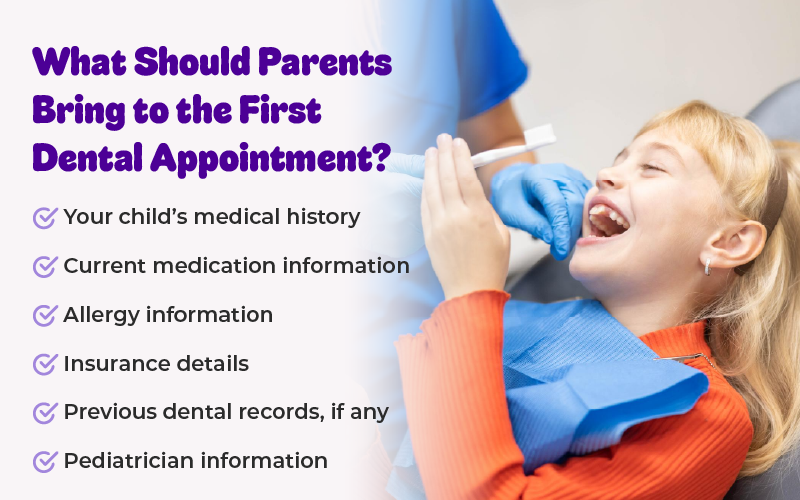
A little preparation can make the appointment easier for everyone.
Before leaving home, check whether the dental office needs:
- Your child’s medical history.
- Current medication information.
- Allergy information.
- Insurance details.
- Previous dental records, if any.
- Pediatrician information.
Most importantly, bring your questions.
You might even write them down on your phone because, let’s be honest, remembering five questions while your toddler is trying to climb the reception desk is harder than it sounds.
Questions to ask the dentist
Consider asking:
- Are my child’s teeth developing normally?
- How much fluoride toothpaste should we use?
- How often should we brush?
- Is my child’s diet increasing their risk of cavities?
- Is their pacifier or thumb-sucking habit something we should be concerned about?
- Does my child need fluoride treatment?
- How often should we schedule dental checkups?
Your child’s dentist can give you advice based on your child’s actual teeth, habits, and cavity risk rather than a generic checklist from the internet.
How Much Toothpaste Should a Child Use?
This is one of the questions that may seem easy but can actually bring a lot of confusion. The ADA states that fluoride toothpaste should be used as soon as teeth appear.
Children aged less than 3 years
They should use only a smear of toothpaste, which is similar in size to a rice grain.
Children aged 3 to 6 years
They may only use a small portion about the size of a pea.
Children should either have someone assist them in brushing, depending on their age and motor skills.
The ADA says that children should brush their teeth twice daily.
Simple Toothpaste Guide
| Age | Recommended amount of fluoride toothpaste |
| First tooth to under 3 years | Rice-sized smear |
| 3 to 6 years | Pea-sized amount |
| Older children | Follow dentist’s guidance |
The goal isn’t to cover the toothbrush in toothpaste.
It’s consistent brushing.
WHY ARE BABY TEETH IMPORTANT?
“Baby teeth fall out after all.”
You have probably heard that before. While that sounds true, it does not mean you should neglect them.
Baby teeth are essential for chewing, speaking, and reserving space for the formation of adult teeth. Teeth deterioration might bring discomfort and complications.
Therefore, these baby teeth need proper care.
What to Do When a Baby Tooth Develops a Cavity?
Do not think that it is possible to skip the treatment just because the tooth will be lost sooner or later.
The dentist can estimate the need for treatment by taking into account the type of tooth, the child’s age, decay severity, and the expected time to lose the tooth.
Still, the best scenario is to prevent cavities at all.
What If Your Child Is Afraid of the Dentist?
To begin with, keep in mind that you may not necessarily have done anything wrong. Some children merely take longer than others to adapt to new people and environments.
A dentist’s office is probably overwhelming for a little child: strong lights, unusual sounds, foreign machines, and an unknown adult asking if they can look in a child’s mouth.
That is surely an overwhelming sensory experience for a small child.
How Can You Make the Visit Easier?
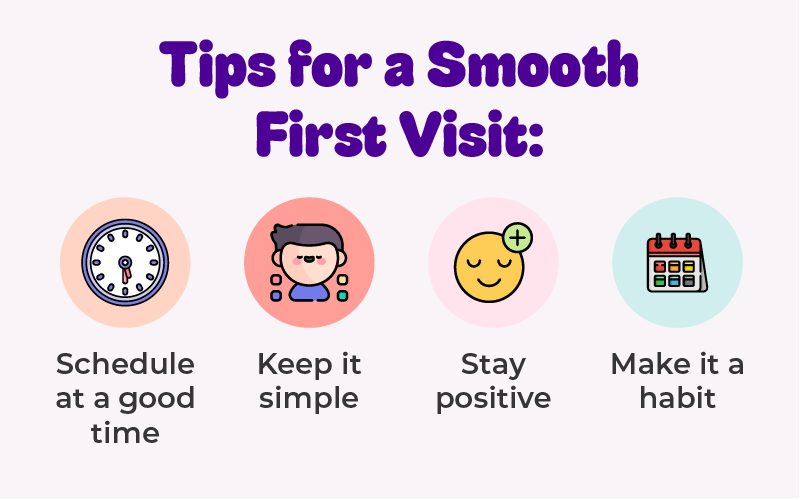
Keep the following tips in mind:
- Be calm and optimistic.
- Use simple language to describe the visit.
- Do not scare your child by talking about dental procedures.
- Avoid introducing the dentist as a disciplinary measure.
- Let the dental staff communicate with your child.
- Reward even the slightest moment of good behavior.
- Bring some familiar comforting item from home, provided that the dental office allows it.
- Let your child acclimatize to the office for some time.
And if your child cries?
Just let them cry.
It is possible to have a successful first visit without the fear of a dentist forever.
HOW OFTEN SHOULD CHILDREN GO TO THE DENTIST?
Not every child has a consistent dental visit schedule.
The frequency of dental visits may depend on your child’s oral health and the risk of cavities. Six-month checkups are standard dental visits, but some children may need more frequent visits. According to the American Academy of Pediatric Dentistry: Periodicity of Examination and Preventive Dental Services, the dentist may recommend the frequency of dental visits.
What is important is to get regular dental care rather than wait until your child has dental pain.
WHAT OTHER PARENTS DON’T ALWAYS HEAR ABOUT THE FIRST DENTAL VISIT
This is an aspect most people miss.
The initial visit to the dentist’s office is not just about your child’s dental issues but about providing parents with what to notice in terms of their child’s dental health in between visits.
When you leave the office, you will know how much toothpaste to use, whether your child’s diet is affecting their teeth positively or negatively, and which habits need adjusting.
It is crucial because children’s mouths change fast.
A question that seems trivial today, such as whether your child is always drinking juice or goes to sleep with a bottle, becomes significant once you understand how these actions affect their teeth.
At your first appointment, you will set a standard.
Early visits help dentists create a baseline.
Further appointments will help determine your child’s tooth growth and development, dental hygiene, susceptibility to cavities, and other age-related factors.
FIRST DENTAL VISIT FOR CHILDREN: A PARENT CHECKLIST
Before the Visit
- Make a dental appointment as early as the first birthday.
- Complete all the dental office paperwork.
- Take along relevant medical and medication information.
- Prepare questions related to the visit.
- Keep it simple when explaining the visit.
- Avoid tales that could frighten the child.
- Follow your usual schedule with the child.
During the Visit
- Tell the dentist what toothbrush your child uses.
- Mention any concerns about dental problems.
- Ask about fluoride toothpaste.
- Inquire about the likelihood of cavities.
- Discuss your child’s diet.
- Discuss any habits involving thumb sucking or using a pacifier.
- Clarify when the next visit should take place.
Following the Visit
- Follow recommendations for brushing.
- Use fluoride toothpaste only if appropriate for the age.
- Follow any dietary advice given.
Final Thought
Your child’s initial dental visit doesn’t have to be anything traumatic. It could either be ten minutes of cooperation followed by ten minutes of crying, with your toddler either willingly opening their mouth or strongly resisting anyone getting work near their teeth.
In either case, you are embarking on something important.
The goal of first dental visits for children is not perfection but prevention, getting used to being at a dentist’s office, and establishing a healthy routine.
If your child has not had their first appointment yet, check their age and when they got their first tooth, and make that appointment now.
Your future self would surely have wished you did so, especially if it was caused by a toothache at night.
Frequently Asked Questions
It is generally recommended that a child visit the dentist before their first birthday and within six months of getting their first tooth. This helps prevent dental issues and develop good habits around oral care.
A visit to the dentist includes checking for any tooth or gum problems. The dentist will look for cavities or other problems with your child's teeth and advise you about brushing, fluoride, and feeding habits, along with answering your questions.
It is important to keep things positive and simple. Let the child know that the dentist will be checking their teeth, avoid negative and frightening words, and perhaps pretend to be a dentist at home.
Yes, fluoride toothpaste is safe from the time the first tooth erupts. For children below 3, use fluoride toothpaste that is the size of a grain of rice. For children between 3 and 6, use a pea-sized amount of toothpaste.
Do not worry. It is normal for young children to cry during new experiences. Try to stay composed and calm, and let the dental staff take charge of the appointment.