


You lose a tooth, and suddenly, something you never thought about becomes impossible to ignore.
You may be avoiding certain foods. You may be smiling a little less. Or you may always notice the gap when you look in the mirror. And then your dentist informs you of dental implants, and you think, wait, what exactly are they going to do? Will it hurt? How long is the recovery process?
You may be nervous; that is entirely normal.
Dental implants involve a surgical process, and anything that involves surgery sounds scary. But knowing what is involved can relieve a tremendous amount of stress. You don’t need to know everything before your visit, but you should at least know what will happen.
What Is a Dental Implant?
Before we begin, let us clarify a common misconception.
The implant is not the visible tooth you show when you smile, but rather a part of the structure below.
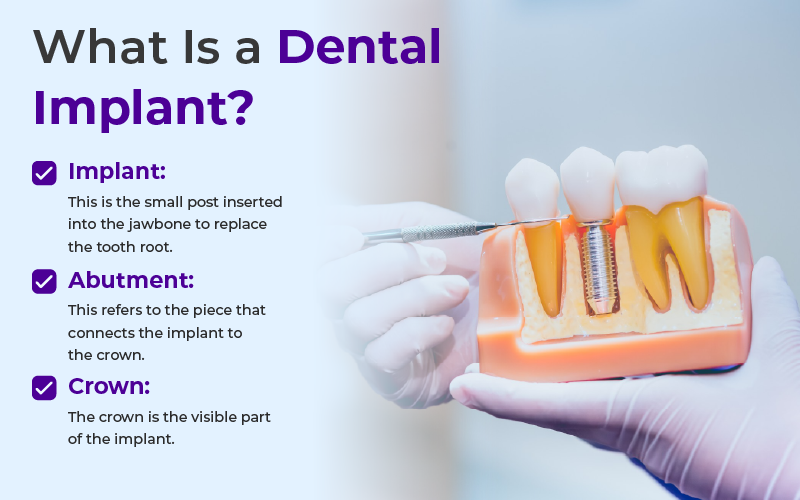
A dental implant has three main components:
- Implant: This is the small post inserted into the jawbone to replace the tooth root.
- Abutment: This refers to the piece that connects the implant to the crown.
- Crown: The crown is the visible part of the implant.
The goal is to create a replacement that feels like a natural part of your mouth when you chew.
The procedure is lengthy because your body needs time to heal before the treatment can be completed.
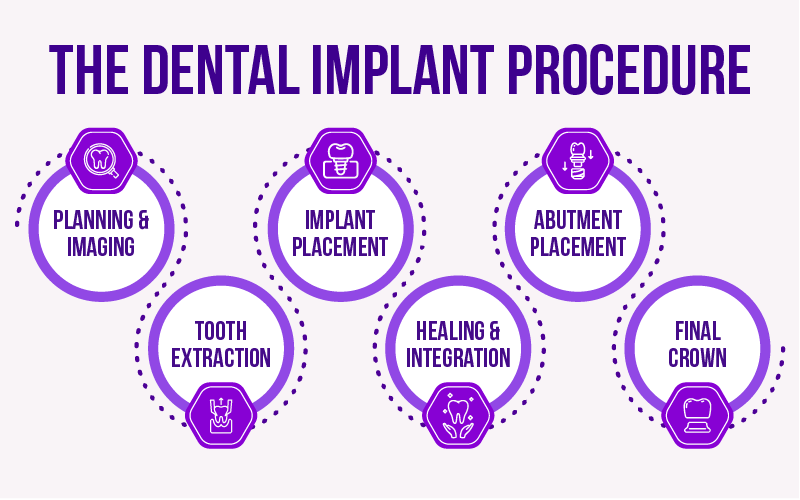
Step 1: Your Dentist Makes Sure You’re a Good Candidate
The first meeting doesn’t involve picking up the drill and getting to work. Instead, it is to check your mouth.
Your dentist will assess your gums and teeth and may take X-rays or 3D scans of your jawbone to determine whether you have enough healthy bone to support the implant. The dentist will also check for issues such as gum disease and infections in your mouth.
Why is this assessment so important?
Your jawbone may have good support, and you may be able to get an implant sooner than others. In the meantime, someone else may need to treat gum disease or get a bone graft before implant placement.
If you discover that you need some extra treatments, don’t think that something is wrong with your mouth. Your dentist is simply doing everything possible to allow for proper bone support.
Moreover, this is the right time to ask any questions you have.
Step 2: The Damaged Tooth May Need to Be Removed
If your tooth is still there but severely damaged, your dentist will probably have to remove it.
In some cases, the implant could be inserted at the same time as the extraction. In other situations, however, it’s best to wait so that your mouth can heal.
The final decision depends on factors such as the presence of an infection, the state of the bones and gums, etc.
It can be annoying to hear that you might have to wait. You probably think: I’ve already waited so long; can’t we just solve my problem?
Unfortunately, quick implant procedures are not the best option.
Step 3: Your Dentist Places the Implant
The process can indeed make you feel a bit nervous. It’s the moment when the doctor will begin to work using the anesthesia to numb the concerned area. Additionally, sedation may also be suggested.
In the end, after numbing and preparing you has been done, the placement of the implant will commence, during which the doctor will drill a tiny hole in your jawbone.
The process will cause pressure, vibration, and slight movements at the site of the operation.
However, even if you feel something, you should not feel sharp pain since the area has already been numbed.
It must be highlighted that it is not necessary to feel courageous to go through the procedure, as you can let the doctors know about your anxiety.
Step 4: Your Body Does Some of the Work
After the implant is inserted, the dentist’s work isn’t over; the body takes over from there. After the procedure, a series of weeks and months is needed for the jawbone to merge with the implant, the process of which is known as osseointegration.
Why does this take time?
Because bone healing cannot be rushed, recovery time may vary based on your condition, bone health, implant location, and whether any other procedures, including grafting, were performed.
The waiting time can be longer than expected.
You may feel anxious looking at your temporary tooth or healing spot and wonder when you will get back on track.
In this case, you have to be patient.
Your dentist can estimate recovery progress by closely monitoring your healing and inform you of the next steps.
Step 5: The Abutment Is Added
Once the implant has established an adequate bond with your jawbone, the dentist will mount the abutment.
Simply put, this connector is the piece attached to the implant that goes underneath the gum line, and the new tooth is placed on top. The abutment placement can coincide with the implant procedure or take place in a separate session.
If the implant has been covered with tissue during healing, the dentist will first make it accessible to mount the abutment. This stage is often much shorter than the initial tooth implant procedure.
You are very close now.
Step 6: Your New Crown Is Made
Next up is a phase that feels similar to previous dental procedures: fabricating an actual tooth.
To make this happen, your dentist may take digital scans or impressions to capture the size and shape of your mouth, so they know which crown will fit properly when placed.
This means the tooth will not be perfect, but it won’t look unusual compared to natural teeth. When the crown is manufactured, the dentist will place it on the abutment.
Are Dental Implants Painful?
Let’s face it, “it doesn’t hurt at all” is hardly an appropriate response. Is there pain involved with getting dental implants? During the procedure, the dentist will numb the area, so you’re unlikely to feel much pain. You may experience some pressure and other sensations.
After the procedure, your mouth may be sore, swollen, bruised, or tender as it heals.
Most people find this discomfort goes away with the treatment and medication provided by the dentist.
If you are worried about the possibility of pain, please talk to your dentist before the treatment starts and get informed about the anesthesia and sedation options.
To learn more about dental implants, you can read our blog here :
How Long Does a Dental Implant Procedure Take?
So, how long does a dental implant procedure take?
This is not an easy question to answer, since dental implant treatment may involve more than one procedure. It can take anywhere from 30 minutes to several hours to place a dental implant depending on the number of implants placed and the complexity of the surgery.
However, implant treatment may take months to finish because your jawbone needs time to heal properly and fuse with the implant.
For example, someone with healthy bones may undergo a relatively simple procedure to get one implant.
Lastly, some patients undergo extraction, bone grafting, or treatment of gum issues before dental implants are placed.
What Should You Expect During Dental Implant Recovery?
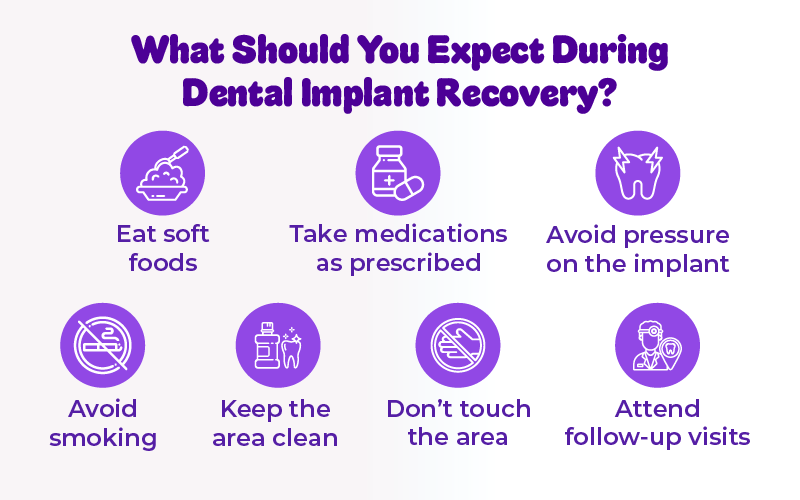
The first few days are usually when you’ll notice the most tenderness or swelling. You don’t necessarily need to hide away from the world, but your mouth will appreciate some kindness.
Simple dental implant recovery tips
Your dentist will provide specific guidance based on your situation; however, here are some general tips:
- Eat soft foods if chewing becomes painful.
- Follow your physician’s prescriptions and instructions.
- Do not smoke since that could hamper your recovery.
- Keep the surgical site clean as instructed by the dentist.
- Avoid putting unnecessary pressure on the implant area.
- Do not touch it with your fingers or tongue.
- Keep your appointments with your doctor.
Make sure you get in touch with your doctor if you feel pain or observe unusual bleeding.
What Is the Dental Implant Success Rate?
It’s easy to wonder whether all that time, treatment, and money are worth it.
Dental implants generally have success rates, usually around 90-95% or higher, depending on factors such as implant location, patient health, follow-up time, etc.
However, there is an important point: a dental implant is not completely free of maintenance.
Your gums and the jawbone around the implant still require care. Smoking, poor hygiene, gum disease, and certain health conditions can affect implant success in the long run.
That’s why dentists don’t just place a post and wait for the best outcome.
Dental Implant Aftercare: Your Part of the Journey
Aftercare for your dental implant helps preserve the result you’ve achieved.
Make sure you brush your teeth regularly, floss where necessary, and visit your dentist regularly. You may be recommended certain accessories, such as a special toothbrush, special floss, or certain techniques based on the type of implants you have.
While an implant cannot decay like a natural tooth because it is not made out of the same natural substance as a regular tooth, dental implants still require proper care–although complications affecting the tissues surrounding the implant can still occur.
Final Thought!
For many individuals, a dental implant is about regaining something that has silently disappeared after the loss of their tooth: assurance.
Maybe it is the ability to bite into an apple without giving it another thought, to smile freely without hiding it, or to take a picture without considering the angle beforehand.
All these small things can be more important than you can imagine.
When you think of dental implants, there is no need to make hasty decisions; the first step is to talk with a professional about your mouth’s needs, the alternatives available to you, how long the entire treatment will take, and what recovery will actually look like.
Even though many people assume the quickest treatment plan is the best, the optimal plan is the one that helps you resume smiling, eating, talking, and living in comfort.
Frequently Asked Questions
The procedure itself takes one to two hours per implant. The entire process, including healing and the final crown, can take three to eight months, depending on bone health, healing speed, and whether a bone graft is needed.
You will not experience any pain during the procedure itself as anesthesia will be applied. After the procedure, you may feel some pain and swelling for a few days, similar to a tooth extraction; at worst, it will be moderate discomfort that can be managed with over-the-counter medication.
The success rate is generally very good. Research suggests a success rate of somewhere between 95% and 98%. However, some factors like being a smoker or having uncontrolled diabetes affect the success of the process a little. Good preparation and aftercare can improve the above numbers.
Not quite. For the first few days after the procedure, you should eat only soft foods (stewed apples, mashed potatoes, soup, etc.). You must avoid any crunchy or spicy dishes, as well as drinking through a straw.
Skipping aftercare, for example, ignoring rinsing instructions or smoking after the procedure, can interfere with the healing process, causing the whole implant to fail. Since the rate of success of this procedure is highly dependent on the proper fusion with the bone, it is not worth taking a shortcut.