


Have you ever experienced a moment when you are just sitting there drinking your first cup of coffee for the day, minding your own business and your dentures decide to shift like they are on a magic show? You feel frozen, clenching your jaw, hoping that they will stay in place until you can find a restroom to fix them.
If this sounds familiar, then you are not alone. At some point after getting used to your dentures, you may start to ask yourself the question that many long-term denture wearers ask.
“Is it possible to get dental implants after being a full-time denture wearer? Did I wait too long to do this?”
Here is the part you may not believe. Your window is very rarely closed; you probably have more options than you think.
So let’s talk about this.
Get Dental Implants Even If You Wear Dentures
Yes, you can switch from wearing dentures to implants for dentures. You can also change from using dentures to using implant-supported teeth or even convert all of your existing dental work to permanent teeth using dental implants. In most cases, the only major concern is the state of your jawbone. Because dentures rest on your gums, they do not provide stimulation to your jawbone like natural teeth. Therefore, over time, your jawbone shrinks.
However, there are still a few options for you if your jawbone has shrunk and has no implants or less than sufficient support for implants.
What If Your Bone Isn’t Great Anymore?
A lot of people assume that they don’t have adequate bone when it comes to their dental implants; however, many are surprised to find out they do possess sufficient bone. Moreover, if you have lost a substantial amount of bone due to some type of trauma or disease, your dentist can still offer a dependable treatment plan. Some potential options include: bone grafting, mini implants, and utilizing new anchoring methods to support your dental implant.
So if you are wondering “am I still able to receive a dental implant after I had a full set of dentures,” the answer is an overwhelming Yes; you will just need to have a clinician provide you with a tailored treatment plan based upon your individual case.
Why You Might Want Implants After Wearing Dentures for Years
If we’re being truthful, traditional dentures can be effective but also have their fair share of challenges that never disappear. Wobbling dentures, adhesives required to keep them in place and soft foods that leave you feeling like you are being punished are just a few examples. And let’s not forget the little bit of fear that is always present when laughing or sneezing with dentures in your mouth.
People don’t change from their own teeth and traditional dentures to dental implants and dentures because they would like a fresh start; rather, they are ready to stop compromising with their teeth.
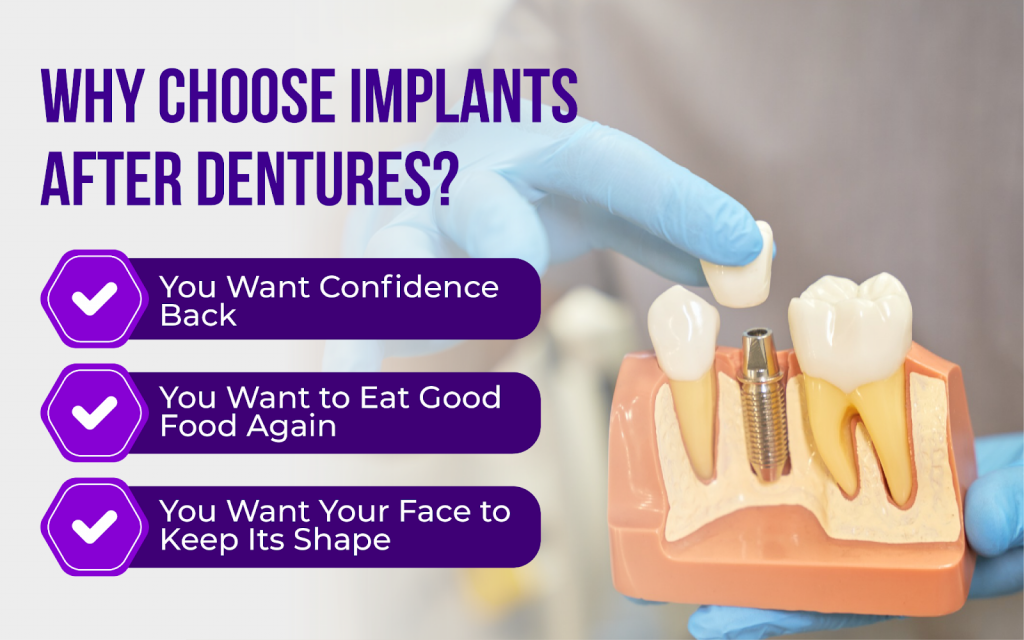
You Want Confidence Back
The confidence associated with having your teeth is different than what you experience when you have lost your teeth. You are able to laugh more, speak without having to think about suction and take pictures without worrying if your smile will shift.
This is not a matter of vanity. It is a matter of comfort and comfort is critically important to you.
You Want to Eat Good Food Again
When you replace your teeth using an implant retained denture, your upper palate is not covered with denture. This one factor can significantly improve the taste of foods. In addition, you will once again be able to bite into food with trust, rather than side to side or cautious.
You Want Your Face to Keep Its Shape
Most people don’t realize when you you replace teeth with dentures it will gradually cause the bone to shrink beneath your gums. As the bone shrinks, it will change the shape or structure of your face over a long period of time. Implants stimulate bone so that it remains healthier.
If you feel like your face looks older than it should, there’s a reason.
What Options You Actually Have When Switching From Dentures to Implants
If you believe implants are just “a single kind,” then you will appreciate this area. There’s plenty of options to suit various lifestyles, preferences and budget for a dental implant.
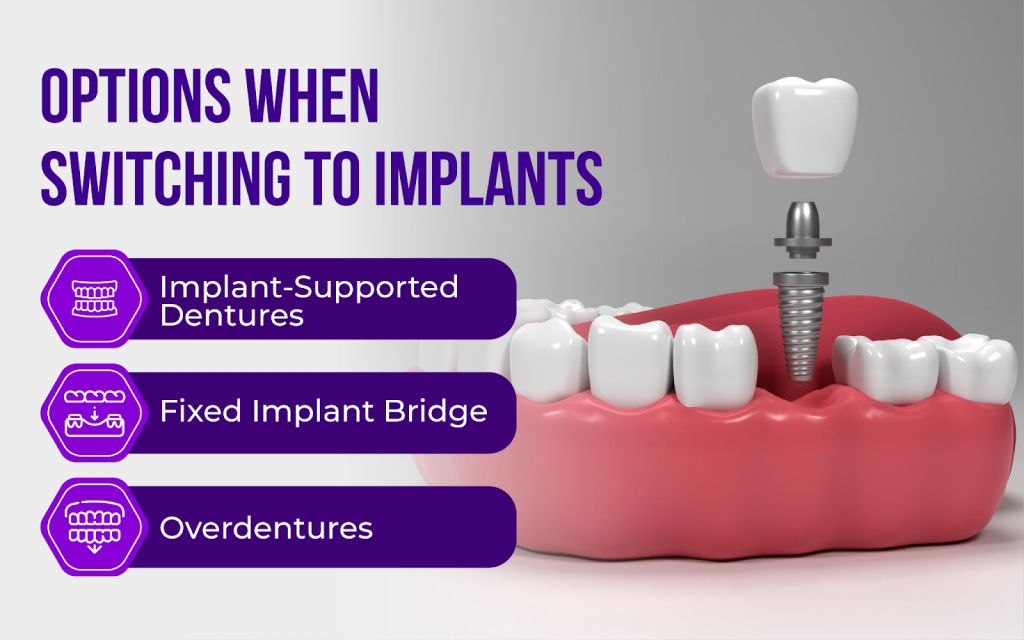
Implant-Supported Dentures
Although it’s still a denture, this type uses dental implants in conjunction with dentures to ensure the denture locks into position. They lock onto and off of, and don’t require any adhesive, and provide a stable base for the denture. If you’re looking for some stability without having teeth that are fully fixed to your mouth, this is a great option for you.
Fixed Implant Bridge
This is about as close to having your own real teeth as possible. They don’t come out at night, and will stay put, so you can treat them like your real teeth and will fit and function like your real teeth as well. If you are tired of taking your teeth out like they’re an accessory that you can put in and out of your mouth, this is probably what you are looking for.
Overdentures
Overdentures rest on your implants for support and are easily removed so that you can clean your overdentures like you do your regular dentures. You can think of them as a newer model of dentures that actually function correctly. For many people, this is an excellent starting point if they are having issues with committing to a permanent fixed solution.
What the Denture Implants Procedure Actually Feels Like
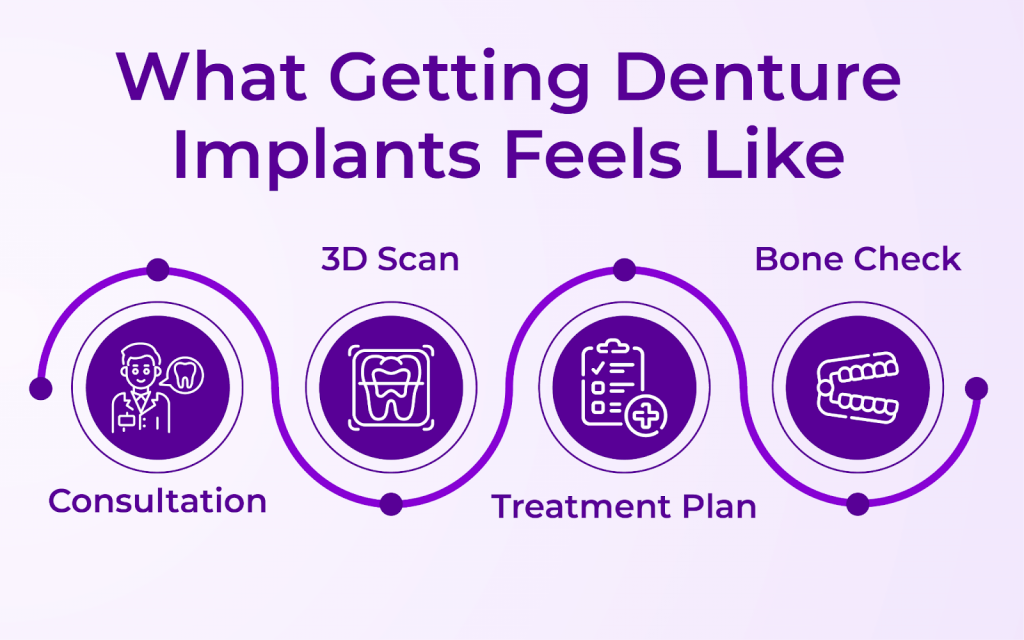
What might seem like an extreme situation will instead turn out to be a very exact series of events – which is not how many people picture it would be.
- You have a personal meeting with your dentist and they take a 3D X-ray (or scan) of your jawbone.
- While you are still in their office, your dentist will look at your X-ray and discuss with you the options that are available to you. Your dentist will not make you feel bad about everything prior to becoming a denture wearer.
- If you already have bone, awesome! If you don’t have enough bone to support implants, we can usually build you some bone.
Once the procedure to insert the implants begins, most people will compare the experience to the ease of getting a tooth extracted (pulled). After the implants heal, you are ready for your new teeth. This is when everything begins to change for the better.
Many people will say things like, “I didn’t even know how much energy I had been wasting worrying about wearing dentures”. Once you relinquish this worry, you have the opportunity to use your energy in more positive ways. Like smiling at will.
What If You’ve Worn Dentures for Decades?
Yes, it is still possible to receive dental implants. Seriously, it happens every week in dental offices around the country. The key difference between your situation and that of an implant patient is most often the existing quantity of bone. However, even if you are not totally bone-free, it does not eliminate the possibility of your receiving an implant.
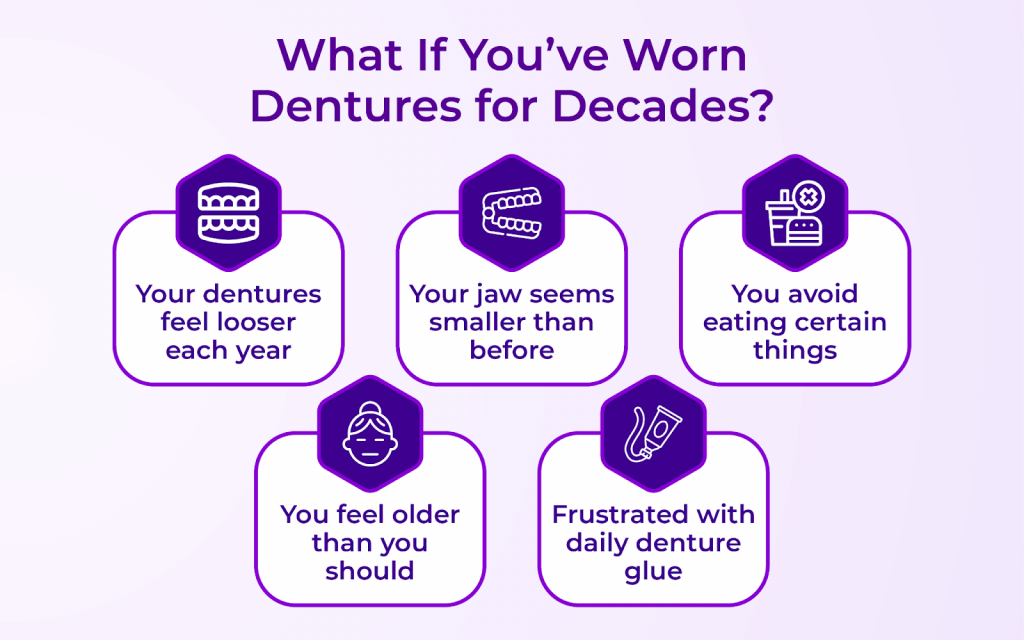
If any of these issues sound familiar to you, then you are in the right place:
- Your dentures feel looser each year
- Your jaw seems smaller than before
- You avoid eating certain things
- You feel older than you should
- You are sick and tired of using glue on your dentures every day
The Emotional Side to Talk About
This is the part that most blogs skip over; living with dentures diminishes your self-esteem in many little ways which then accumulate and become larger issues over time. Your laughter becomes softer; your eating habits slow down; and you develop a tendency to speak slowly so that you don’t drop your dentures out of your mouth (even though they aren’t going anywhere). Before long you have changed parts of your personality because of your teeth.
When you transition to implants from either dentures or fixed implants, it is much more than simply a dental improvement; it is an improvement in your life as well! It restores many of the parts of yourself you were unaware you had locked away because of your teeth.
People have shared with me statements like:
- “I didn’t know how much my behaviour would be affected.”
- “I feel younger.”
- “I can’t believe I waited so long to do this.”
Maybe you won’t cry when you transition to implants or fixed implants, but trust me, there are folks who do cry for all the right reasons.
How You Know If You’re Actually a Candidate
Uncertain about dental implants after dentures? You aren’t alone. Consultations are typically very simple, quick, and much more positive than most people think. During a consultation, the dentist will evaluate:
- Your bone
- Your gums
- Your current denture
- Your goals
- Your health history.
If you have been searching for dental implants after dentures, or the use of either method, then you know you have options.
What Life Feels Like With Implant-Supported Teeth
Imagine.
- You consume a meal without a clue about how the meal will be consumed.
- You wear your dentures all day long, never once wondering if they are held on properly.
- You smile in pictures and do not have to worry about readjusting anything.
- You can see yourself in your own skin (you do not feel as old or ugly).
- You feel like your own person again.
The biggest shocker is that you no longer remember you have teeth at all; it appears to be a great weight off your shoulders as well!
Conclusion
If you have thought about the question for an extended period of time, it might be effective to explore it more in-depth. You don’t have to rely solely on dentures as your only option. It is acceptable to prefer the feel of a comfortable smile. It is acceptable to prefer having confidence. It is acceptable to prefer to have teeth that function along with you rather than against you.
Make an appointment for an initial consultation. Use that time to ask questions. Find out the options available to you.
Remember, your smile is intended to make your day-to-day life easier and not to add additional headaches.
Frequently Asked Questions
Yes, most people are still good candidates for implants; however, the dentist will look at your bone quality, but in many cases of bone loss, there are other alternatives to getting implants and the possibility of grafting material on the bone to do the procedure.
There is a very clear difference; they don’t move or wobble and you can eat meals and speak and smile with confidence. Most patients say they feel more natural and secure than traditional dentures.
Varies; some patients get teeth on the same day as the implant, while others may have to wait for healing time because of the placement of the implant; the duration of time will vary from 1 appointment to several months.
Most people find it to be less painful than extracting teeth; they will feel pressure, and very mild discomfort after the procedure that can be relieved with normal medication.
Yes, if you want stability when chewing, better capability to chew, and more comfort long term, most patients say it is worth the cost of having implants because they protect your bone/their confidence level and they will reduce dentures frustrations daily.