Every healthy smile does more than make you look good – it helps to chew properly and comfortably, brings clarity in speaking, and makes you feel more confident in your life. However, dental problems such as missing teeth, cracked or chipped teeth, or severe decay or cavities can impact your day-to-day life. These problems, if not treated on time, can turn into severe problems and will affect your oral health and even your overall well-being.
At Kathy Jacobsen Contemporary Dentistry in Gilbert, Arizona, we find our patients unsure and confused about which restorative treatment can solve their problems. The most common questions we face from our patients are, “How can the damaged tooth be fixed?” or “What are the options available to replace the missing tooth permanently?” The restorative dentistry procedure focuses on solving all these problems and helps in repairing and replacing the damaged or missing tooth, bringing back your smile with the proper functioning of your tooth in a very natural, comfortable, and safe way.
This blog is all about the 3 restorative dentistry procedures, which will help every patient to understand the dental crowns, bridges, and implants procedure, so that you are more confident and aware while discussing your problem and treatment with your dentist.
What is Restorative Dentistry?
Restorative dentistry is a branch of dental care that focuses on restoring and replacing the damaged and missing teeth so that the health, function, and structure of your teeth can be regained. The aim of restorative dental care is not only to restore the appearance of your teeth but to improve the overall functioning of your teeth.
Restorative treatments are a great option for patients who want to:
- Chew their food comfortably and easily
- Prevent any kind of further dental damage to their teeth
- Protect their remaining natural teeth
- Have a proper bite alignment
- Speak comfortably and properly
- Bring back the confidence in their smile
Unlike cosmetic dentistry, which focuses more on enhancing appearance, restorative dental care addresses the functional problems of teeth, along with enhancing the aesthetics of your overall appearance.
Why Restorative Dentistry is Important?
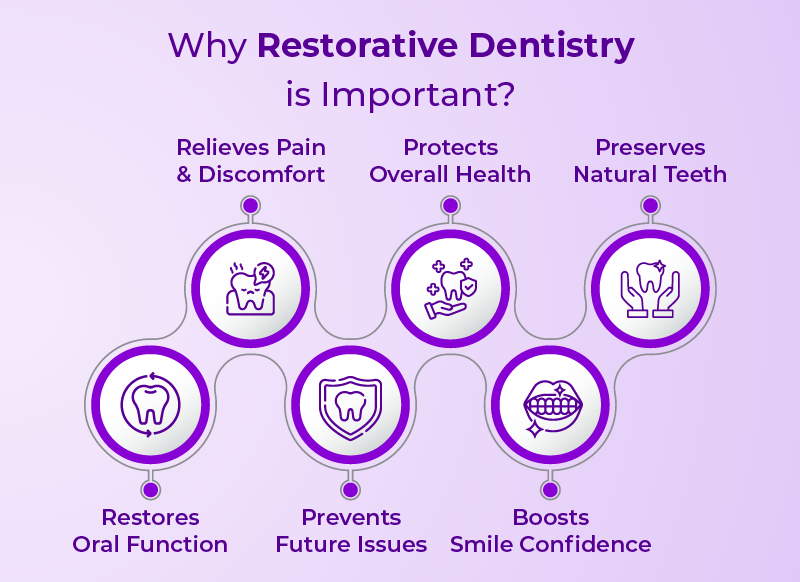
Restorative dentistry is very important as it helps in fixing the damaged teeth, restoring your chewing and speaking functionality, preventing any kind of further decay, reducing pain, and improving your overall appearance.
Some of the key reasons why restorative dentistry is important are:-
- Helps in restoring the oral functioning of your teeth
- Eliminates any kind of pain or discomfort caused by oral problems
- Addresses the problems at an early stage and prevents any kind of future problems
- Untreated dental problems can affect other body organs, like the heart; restorative treatment reduces this risk
- Improves your appearance and boosts your confidence
- Preserves the natural tooth structure
Restorative dentistry procedures stop all the dental problems from progressing while rebuilding the strength and stability of your smile. Treating issues at an early stage avoids more complex treatment procedures at a later stage.
If you are going through the dilemma about which restorative option will suit you, then understanding these basics of restorative treatment can help you to find your answer. Also, our expert dentist at Kathy Jacobsen Contemporary Dentistry can help and guide you about the best restorative treatment for your oral problem.
Types of Restorative Treatments
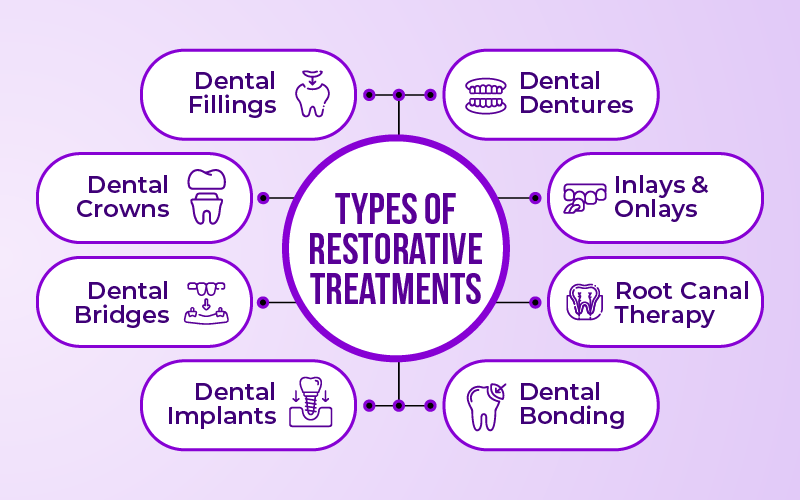
There are various kinds of restorative treatments available in restorative dental care, each solving a different dental problem. Such as fillings are done for small decay problems, crowns uses caps for broken teeth, bridges are used to replace the gaps between teeth, implants are used in surgical root replacement, and dentures are used as removable sets for multiple missing teeth. Other than these, there are some options like inlays/outlays for very large fillings and bonding for chips. All these restorative procedures focus on restoring function, appearance, and oral health.
In this blog, we will go in-depth on 3 restorative treatments: crowns, implants, and bridges.
Dental Crowns
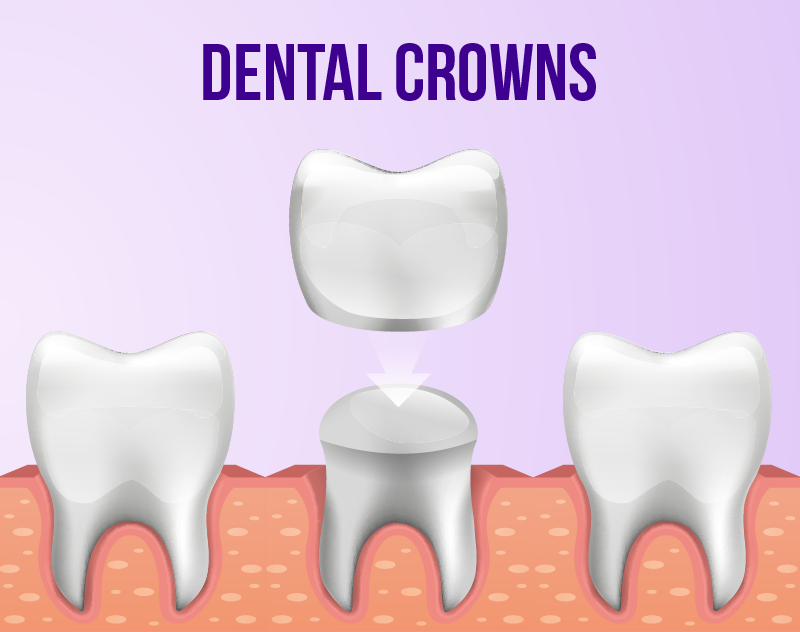
Dental crowns are the most common restorative treatments which are used by dentists in restorative dentistry procedures. The crown, which is a custom-made cap, fits over your damaged or weakened tooth, helping it to restore its shape, strength, and function. You can think of the cap as a helmet that fits over the head and protects it from any kind of damage.
When are Dental Crowns Needed?
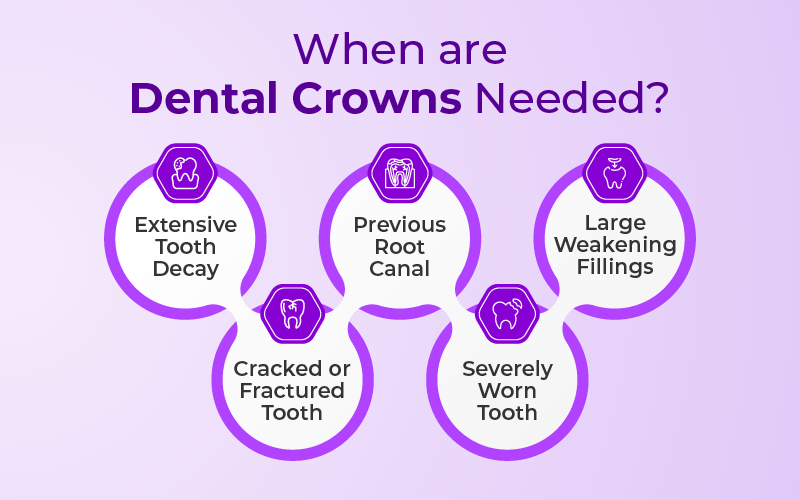
Dental crowns are often recommended by the dentist when:-
- Your tooth has an extensive decay problem
- The tooth is cracked or fractured
- Any root canal treatment has been done for your tooth in the past
- The tooth is severely worn down
- Large fillings are present that weaken the tooth
Dental crowns protect the tooth structure from damaging further, and help you to bite and chew properly.
How Dental Crowns Work?
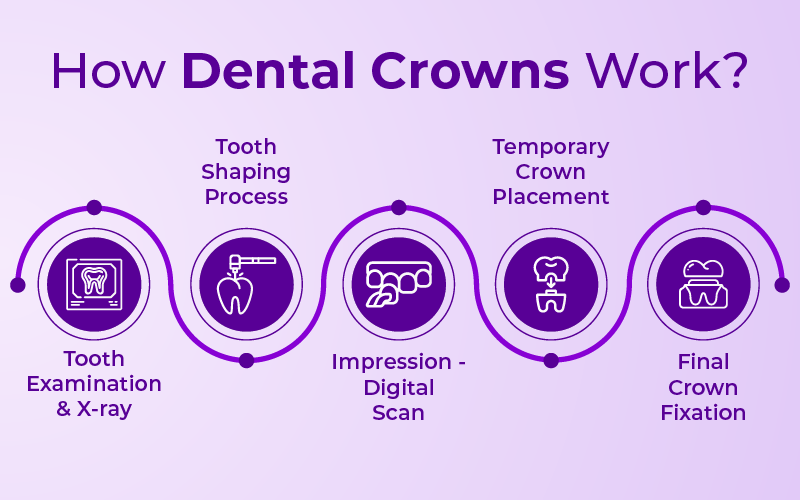
The dental crowns need around 2-3 sittings, where your dentist will examine your tooth, shape it if required, take an impression of your tooth, and finally place the crown.
The process of dental crown restorative treatment involves the following steps:-
- Examining the damaged tooth and taking its X-Ray to get the actual condition of the tooth.
- Shaping of the tooth so as to make space to fit your crown over the damaged tooth.
- Taking impressions or doing digital scans of the tooth.
- Placing a temporary crown over the tooth, this is an optional step.
- Once the crown has been created, the dentist places it over the tooth and fixes it.
The crowns are designed to match the exact color and shape of your original tooth, so as to make it more functional and also visually appealing.
Benefits of Dental Crowns
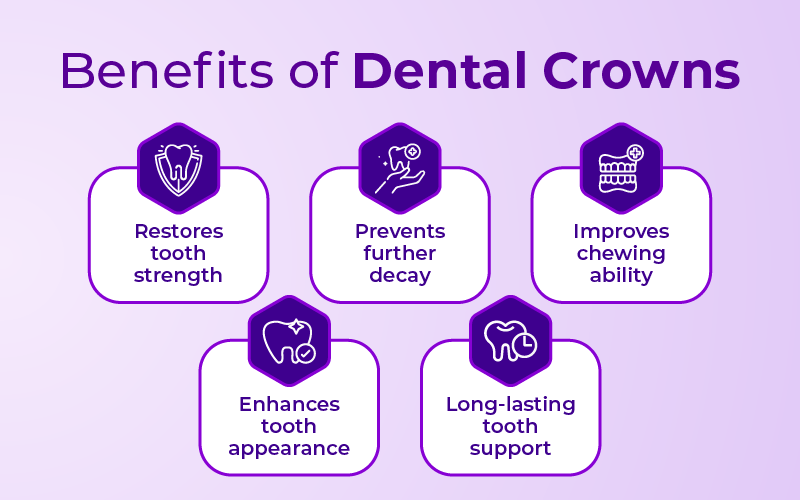
Having dental crowns provides a number of benefits, such as:-
- It helps to restore the strength of your tooth
- Protects the tooth from any kind of further decay or damage
- Improves your chewing ability
- Enhances your tooth appearance
- They are long lasting support for your tooth if properly taken care of.
If you have any damaged or decay tooth, you can consult our experts at Kathy Jacobsen Contemporary Dentistry for the dental crown restorative treatments, and they will be happy to help you through the crown journey.
Dental Bridges
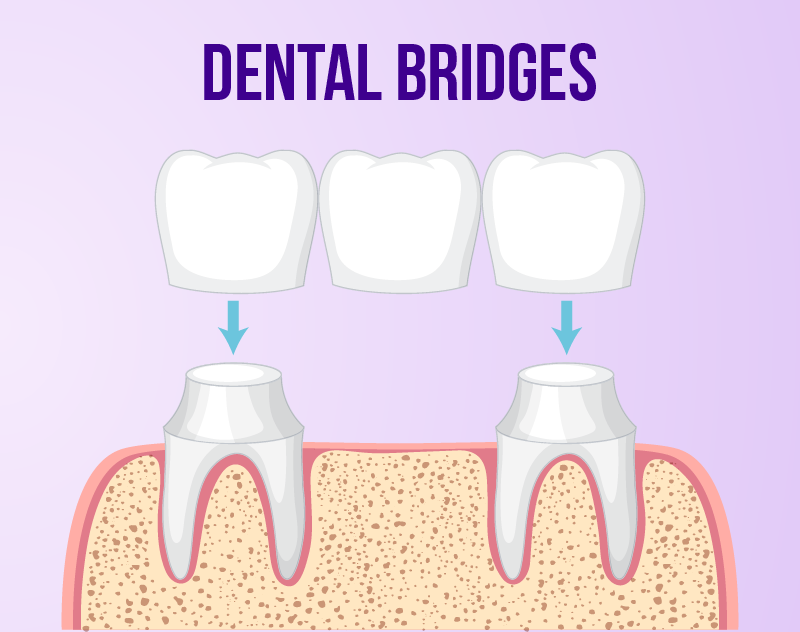
Dental bridges are a restorative treatment that is used to replace the gap caused by a missing tooth or a row of missing teeth. As its name indicates, it bridges the gap between the teeth. A dentist can create a custom bridge that will match the exact shade of your natural teeth. A dental bridge consists of a crown called as abutments and an artificial tooth called as pontics. It aims to restore chewing functionality, enhance your appearance, and improve your overall well-being.
When are Dental Bridges Needed?
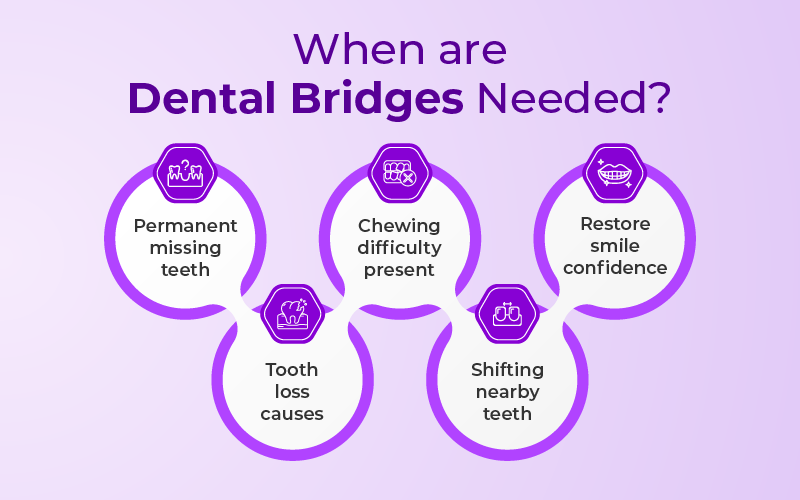
Dental bridges are needed when:-
- You have one or more permanently missing teeth.
- Tooth loss is due to an injury, gum disease, or any kind of decay.
- If you are facing a problem in chewing due to a tooth gap.
- If due to a missing tooth, the neighbouring teeth are shifting.
- To restore your smile and confidence.
Your dentist will examine your oral condition, and only then will they suggest the dental bridge.
How Dental Bridges Work?
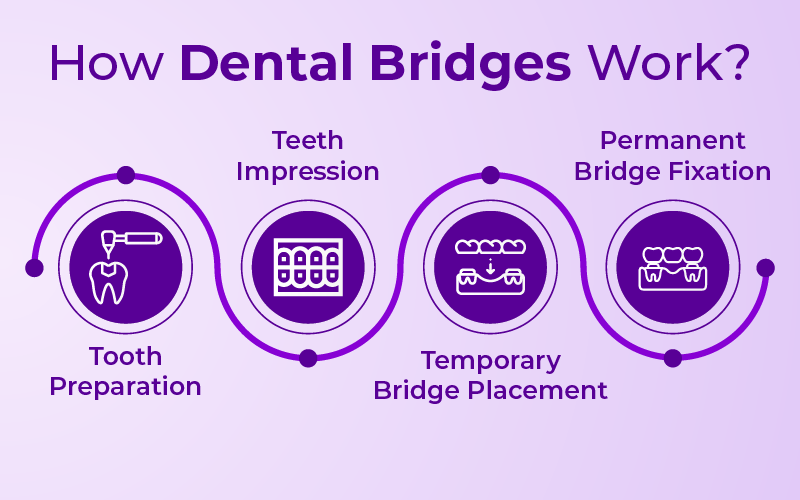
As the name suggests, dental bridges bridge the gap between the missing teeth. There are two main components in a dental bridge: a pontic, an artificial tooth or teeth that fill the gap; and abutments, a crown that fits over the side teeth to provide support.
There are a few steps in the process of this restorative treatment procedure:-
- Preparation – First, your dentist will numb the area, and then will reshape the side teeth to make space for the crown to fit.
- Impression – Your teeth will be taken and will be sent to the dental lab for creating custom bridge.
- Temporary bridge – Your dentist will place a temporary bridge while the permanent one is being prepared.
- Placement – Finally, your dentist will remove the temporary bridge and fit the permanent bridge. If the patient doesn’t feel any kind of discomfort, then only the dentist will permanently cement the bridge onto the abutments.
The number of Pontics and Abutments used in a dental bridge varies for different patients. So, every dental bridge is personalized according to one’s requirements and is completely personalized for each patient.
Benefits of Dental Bridges
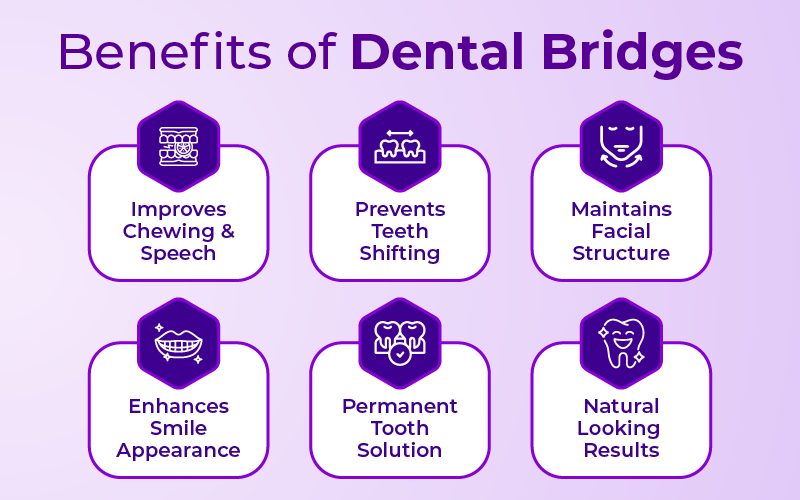
Dental bridges offer many benefits, such as:-
- Ability to chew and speak properly
- Shifting of teeth
- Maintains facial structure
- Enhancing smile appearance
- Provides a permanent solution
- Gives an overall natural look
If you wish to know more about dental bridges read our blog
If you prefer a traditional approach for tooth replacement, you can be a suitable candidate for dental bridges. Our experts at Kathy Jacobsen Contemporary Dentistry are always ready to guide you and answer all your questions related to any dental procedure.
Dental Implants

Dental implants are the most advanced and long-lasting restorative treatment that is used to replace both the tooth and its root, providing stability and function.
An implant is a prosthetic tooth that’s held in place with a screw that’s been surgically installed in the jaw. Implants look just like real teeth, and unlike bridges, implants don’t require the surrounding teeth to be shaved down. Once inserted, they provide support for the crown, bridge, and dentures.
Dental implants also help not only in chewing ability, but in overall oral health. The implants may require a few months to heal, but once healed, they work similarly to a natural tooth.
When are Dental Implants Needed?
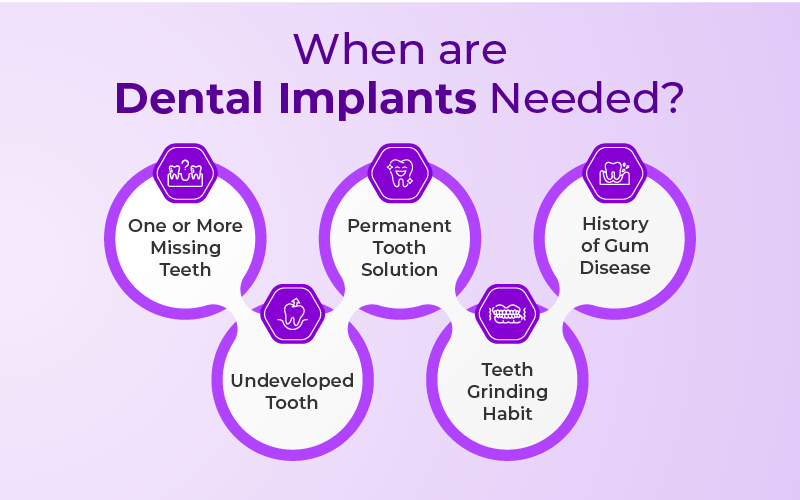
Dental implants are suggested by your dentist if:
- There is one or more missing teeth
- You want a permanent solution for your missing tooth
- If there has been any kind of gum disease
- If you have a tooth that never developed
- If you have a teeth-grinding or clenching habit.
For having dental implants, you need to have adequate jawbone support and healthy gums. Regular oral hygiene routine and dental visits are important for the long term sucess of dental implants.
How Dental Implants Work?

Dental implants have 3 main components:
- Implant – It is the titanium post that is inserted inside the jawbone.
- Abutment – It is a connector that connects the post to the crown.
- Crown/Prosthetic – A customized crown that looks and functions like a natural tooth.
Over time, the implants start integrating with the jawbone and create a strong and stable foundation.
A dental implant is a customized treatment for every patient, but still, there are some steps that are common during this treatment, like:
- Consultation and Planning – Your dentist will observe and check for your oral health, take the X-ray, and do the bone grafting, if required, and then will create a customized plan for your requirements.
- Implant Placement – Your dentist will then insert a screw-like titanium post in the jawbone where your tooth is missing.
- Healing(Osseointegration) – Within a few months, the jawbone will fuse with the implant, creating a strong, stable, and permanent foundation.
- Abutment Attachment – A small connecting piece called an abutment is then attached to the implant post, which extends above the gum line.
- Brown Placement – Once the healing is complete, a natural-looking artificial tooth is placed on the abutment, securing it tightly in position.
In case your implant is near your front teeth, your dentist might give you a temporary tooth to fill the gap for the time being. The healing process can take anything between three to nine months. Our experts at Kathy Jacobsen Contemporary Dentistry are here to guide and help you through your implant journey.
Benefits of Dental Implants
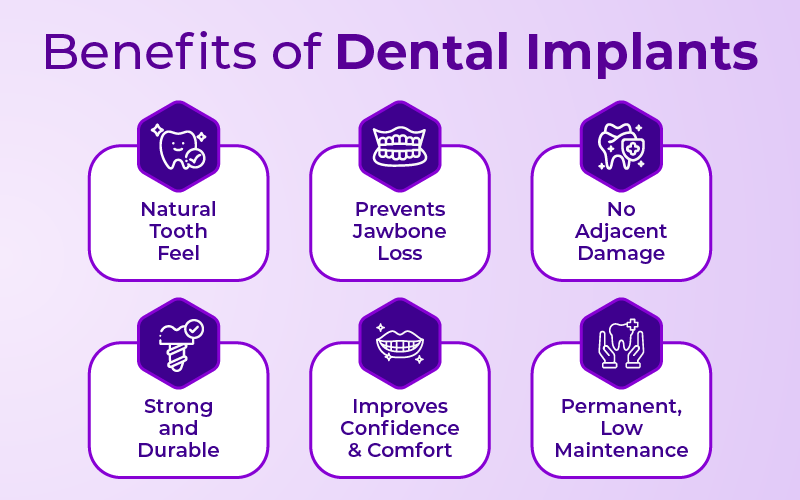
Dental implants have a number of benefits to count on, such as improved eating and speaking ability, restoring your natural appearance, and preserving your natural jawbone. They offer a durable and long-lasting solution for your missing tooth problem without affecting the adjacent teeth.
Some of the key benefits of dental implants are:
- They provide the closest feel to a natural tooth
- They prevent any kind of jawbone loss
- They do not affect your adjacent teeth
- Implants are very long-lasting, durable, and strong
- They improve your confidence and provide comfort in eating and speaking habits.
- They are the permanent solution, so you do not have the hassle of daily removal and cleaning. Just brush and floss as you usually do.
Discover the best ways to care for your dental implants in our blog.
If you’ve lost a tooth, an implant is a great restorative dentistry option. It protects your jaw and gums and ensures you can chew properly. Although they take longer than other restorative treatments, many patients prefer to invest in long-term benefits.
Which Restorative Procedure is best for you?
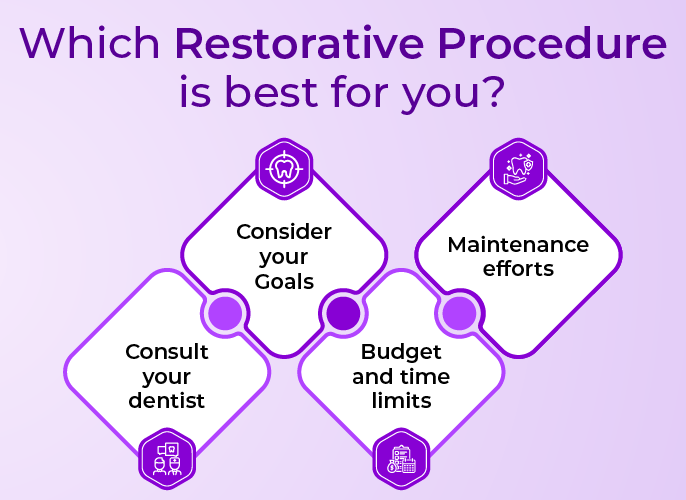
Choosing a restorative treatment among the options available can be overwhelming. But there are few factors that you need to consider when choosing the right restorative treatment.
Key factors to consider when choosing restorative procedure:
- Consult your dentist – your dentist will analyze your oral health condition and will then suggest what’s best for you.
- Consider your Goals – Selecting a restorative procedure largely depends on what goal you want to achieve. Do you want to fix any kind of decay, or replace a missing tooth, or just want to improve your appearance?
- Budget and time limits – You need to check your budget and discuss the time period you have to achieve your goal. For example implants will take a longer time than bridges or crowns.
- Maintenance efforts – You also need to think about the efforts you would require to put in the restorative procedure you will consider. Some procedures are easy to maintain but some need proper take care to last for long term time period.
If you’re unsure which restorative treatment fits your smile, our blog can guide you.
Why Choose Kathy Jacobsen Contemporary Dentistry for Restorative Procedures?
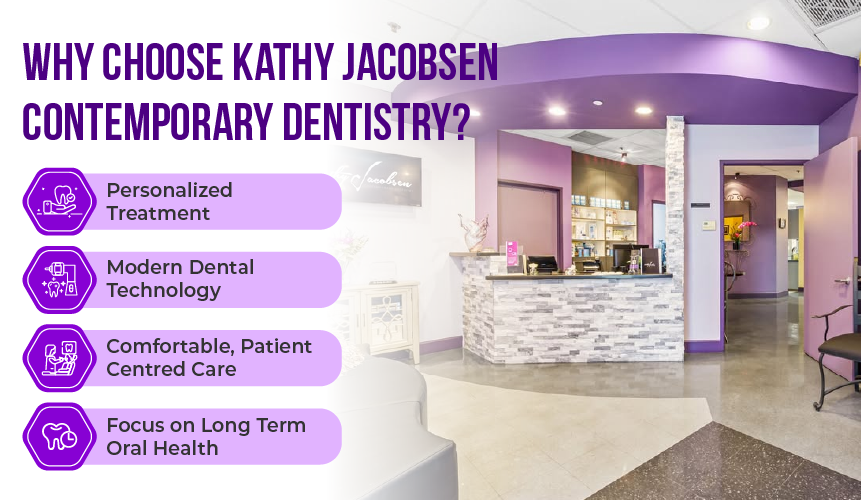
Choosing the right dental clinic and dentist for your restorative treatment is a crucial part. You just don’t need the treatment to be done, but it should be done in a comfortable and convinient way, keeping your goal and requirements in consideration. At Kathy Jacobsen Contemporary Dentistry in Gilbert, Arizona, our expert dentists understands your requirements and build a plan that delivers the results which will support your long term oral health.
Our patients trust us for the care and comfort which they receive during their treatments. As our office manager Skylar says “No two tooth are same, so no two solutions will be same”. Our experts at Contemporary Dentistry are known for:-
- Personalized Treatment – Our experts will take time to evaluate your oral health,discuss your concerns, and understand your goals before recommending any procedure. Our treatment plans are tailored to your needs and not a one size fits all approach.
- Modern Dental Technology – We use advanced dental technology to provide more precise, efficient, and comfortable treatment. Digital imaging, detailed diagnostics, and modern materials allow our experts to plan your treatment more accurately, and eliver the desired results. These technologies also helps in reducing the time for procedure and improves overall outcomes.
- Comfortable, Patient Centred Care – We understand our patients and their anxiety from dental treatments, thats why, our top priority is to provide a calm and comfortable environment to them and explain each and every query of them. We move with the pace that is comfortable for our patients. Our goal is to provide a stress free treatment as much as possible.
- Focus on Long Term Oral Health – We plan our treatments as just not to solve today’s problem , but to consider their long term oral health. We plan our treatments with durability, function, and reventive care in mind. We try to reduce the sk of future tal issues and support a healthier more stable smile over time.
At Kathy Jacobsen Contemporary Dentistry, we are here to guide you, support you, and help you in making decisions that feel right for you. We are committed to go beyond just repairing teeth so that you can move with confidence.
Conclusion
Restorative treatments plays an important part in maintaining your overall appearance, but also helps in providing strength, comfort, and long term goals. Problems like missing tooth, or damaged tooth, effects daily activities like chewing properly or speaking clearly. If not handled on time, these problems can become complex dental issues.
Restorative procedures crowns, bridges, and implants are designed to restore both the functionality and appearance of your teeth. Factors as oral health condition, lifestyle, and your oral goals lay an important role in deciding which restorative treatment is best for you.
At Kathy Jacobsen Contemporary Dentistry, we believe that the restorative care should feel like supportive, comfortable, and stress free. Our experts focus on helping and guiding you to understand the options available and what is best for you. A healthier and ore comfortable smile is always worth investing in – and it starts with right dental practice and dentist.
📞 Call our office to learn more about restorative dentistry options.(CTA banner)
Frequently asked questions
Q1. Are restorative dental procedures painful?
Ans1. No, most restorative dental procedures are not painful as your dentist will give you local anasthesia which will numb you and you won’t feel any sharp pain.
Q2. How long do crowns and bridges last?
Ans2. With excellent oral hygiene, good oral habits, and quality of material used they can last anything between 10-15 years.
Q3. Do dental implants require any special dental care?
Ans3. Dental implants don’t require any special tool, but they require daily, consistent, care just like your natural teeth like brushing,flossing, and antibacterial rinse.
Q4. Can restorative treatments improve the appearance?
Ans4. Yes, restorative treatments can improve your appearance gnificantly by fixing the damaged, decayed, or missing teeth. With these issues tackled your smile looks more perfect, and uniform.
Q5. When should I see my dentist?Ans5. If there is any kind of decayed, damaged, or missing teeth you need to see your dentist and consult about the treatments to restore your oral problems.